- DATE:
- AUTHOR:
- SAP LeanIX Product Team
Product update - October 2026
In October, we closed coverage gaps across your technology and AI landscapes: Custom discovery connectors let you extend inventory to any system that exposes an API, without external infrastructure to provision or maintain. EU AI Act management brings risk classification and compliance tracking to the AI applications already in your inventory. The SAP AI agent discovery integration delivers a unified view of every SAP agent from ownership and identity to runtime verification and enforcement.
Coming in November: A self-service integration to synchronize data between multiple workspaces, IT component successor planning via EA Assistant, and a restructured admin page with clearer AI cost visibility and beta feature activation.
Announcements
Upcoming major changes
NEW: November 13, 2026: Manage your optional and beta features via self-activation (see details below)
March 31, 2027:
Recent feature releases
Inventory any system, even the ones without a standard connector
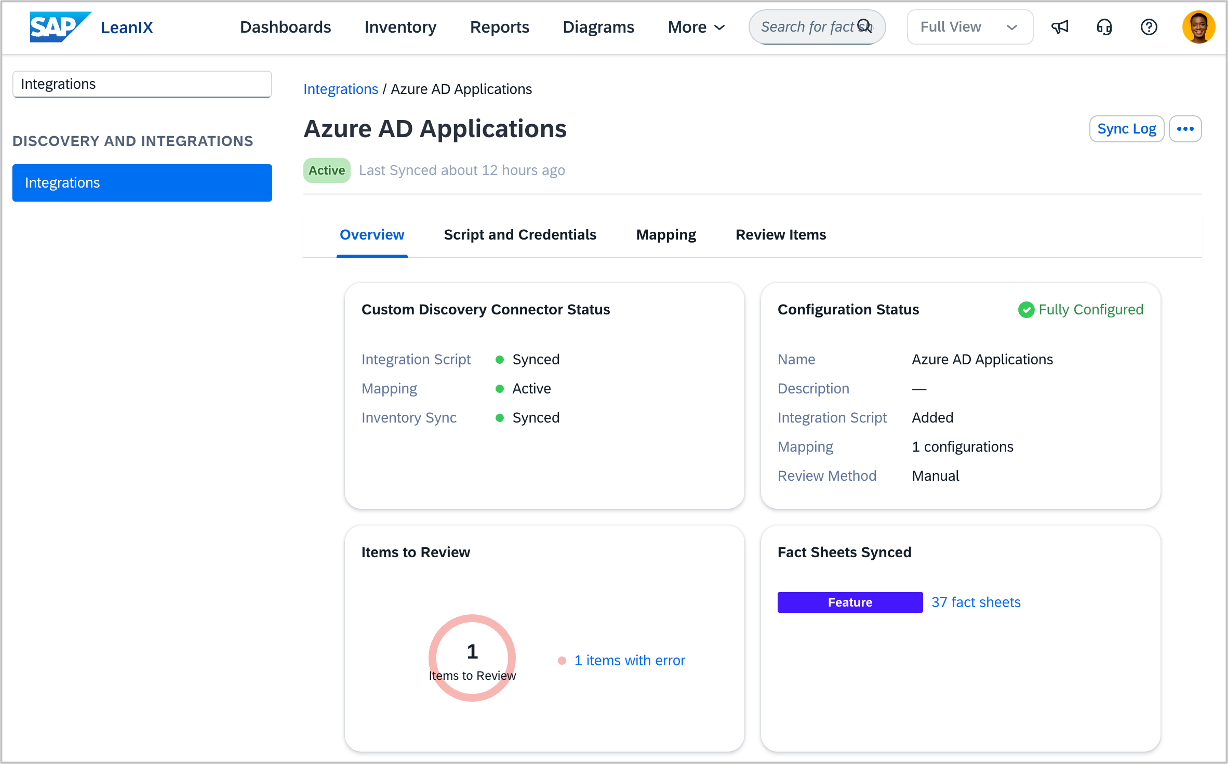
You can now extend discovery to any system that exposes an API, using a custom integration you build, deploy, and run entirely inside your workspace.
Every organization runs systems that fall outside standard connectors: custom-built applications, bespoke vendor platforms, and emerging AI infrastructure. Until now, bridging those gaps required building, hosting, and maintaining a custom integration from scratch. AI coding tools have made writing code faster, but reliably hosting it securely has remained a significant engineering effort. The custom discovery connector eliminates that overhead.
AI-assisted integration authoring: Use the provided AI skill with your preferred coding assistant to describe the source system and what should be discovered. This generates an integration code scaffold using the standard pattern: call the API, transform the data, push to the review area. Refine and validate the code in the in-product code editor, review test results, and deploy with a single click.
Managed execution and credential handling: Integration code runs directly inside your workspace with built-in credential management for API keys, OAuth tokens, and secrets. Subsequent syncs only submit net-new or changed items. There is no infrastructure to provision or maintain.
Review area for custom discoveries: Discovered assets land in a dedicated review area inside each configured integration, giving EA teams a staging environment to review, link, or reject items before they reach the inventory. Per-run sync logs provide full visibility into what was discovered, submitted, and flagged with errors.

Track EU AI Act compliance where your AI systems already live
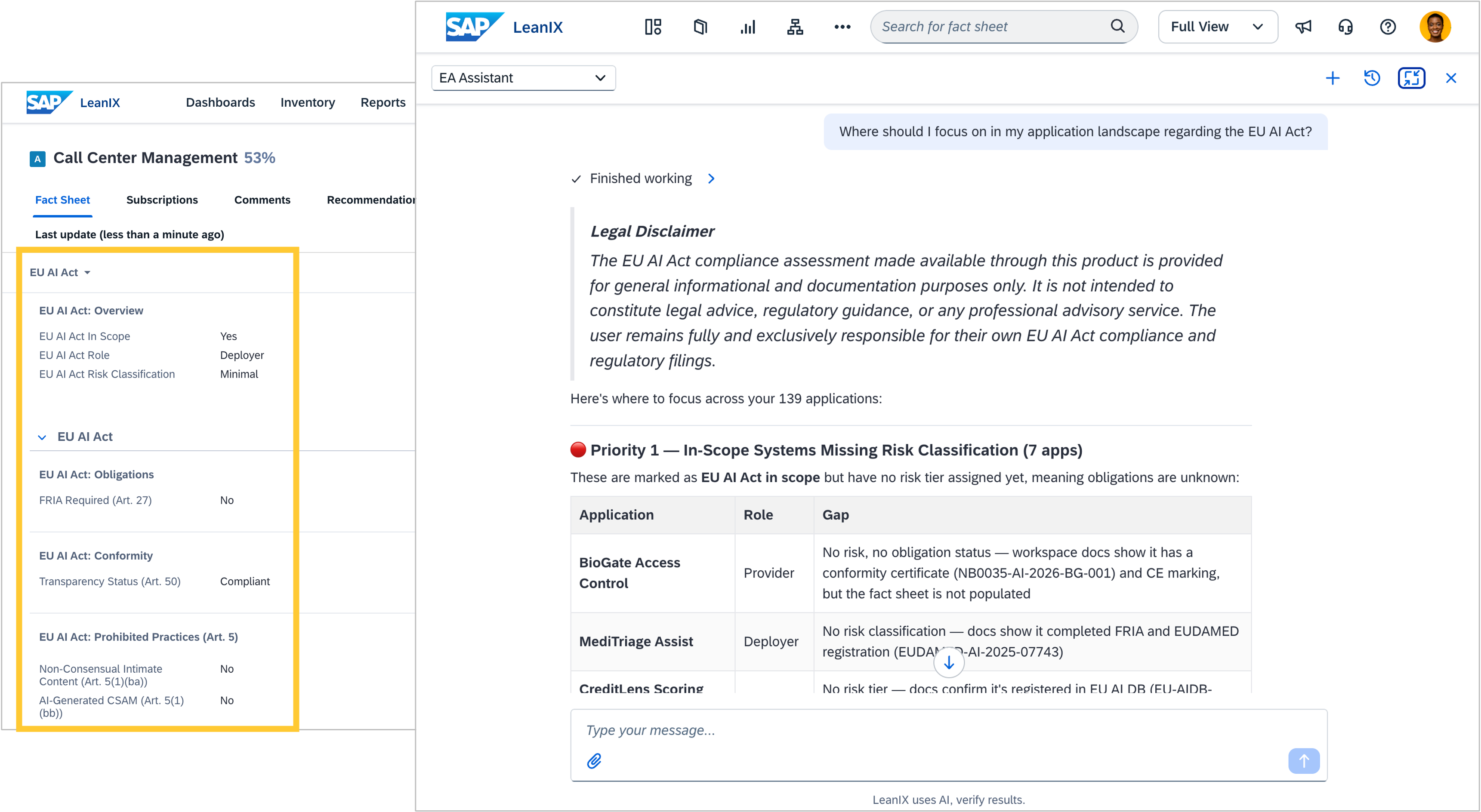
The EU AI Act is now in effect for organizations that develop, deploy, or use AI systems in the EU market. Two complementary new capabilities bring governance for this regulation directly into your inventory and connect it to the AI systems and applications you already manage in your workspace. You get a structured, portfolio-wide view of where the act's considerations apply, without having to recreate data already in the inventory.
Workspace admins can activate the opt-in EU AI Act Management meta model extension to add fields to application fact sheets that cover risk classification, scope determination, and documentation requirements. This extension works best with the AI Governance extension, but doesn't require it to be activated.
The EU AI Act classification is automatically available when using the Enterprise Architecture Assistant to guide you through assessment and gap surfacing across your architecture. It answers questions grounded in the EU AI Act text with citation-backed responses, walks you through risk-tier assessments for prohibited, high-risk, limited, and minimal risk categories, including transparency obligations, and extracts structured answers from your existing documentation, asking only for what's missing and outputting a draft risk tier. It also surfaces fact sheets lacking AI Act fields, pre-fills from completed assessments, and flags suspected high-risk systems without documentation.
All outputs are drafts for your architecture, legal, and compliance teams to review, as the assistant never asserts a compliance verdict. Responsibility for assessing and demonstrating compliance remains with your organization.
Govern every SAP AI agent: from discovery to runtime enforcement
With the release of the SAP Business AI Platform, you can use standard agents built by SAP, create your own agents with Joule Studio, or extend existing agents to meet your specific business needs.
As agent landscapes grow, effective governance starts with a holistic understanding of every agent: what it does, who is accountable for it, where it runs, and how it behaves.
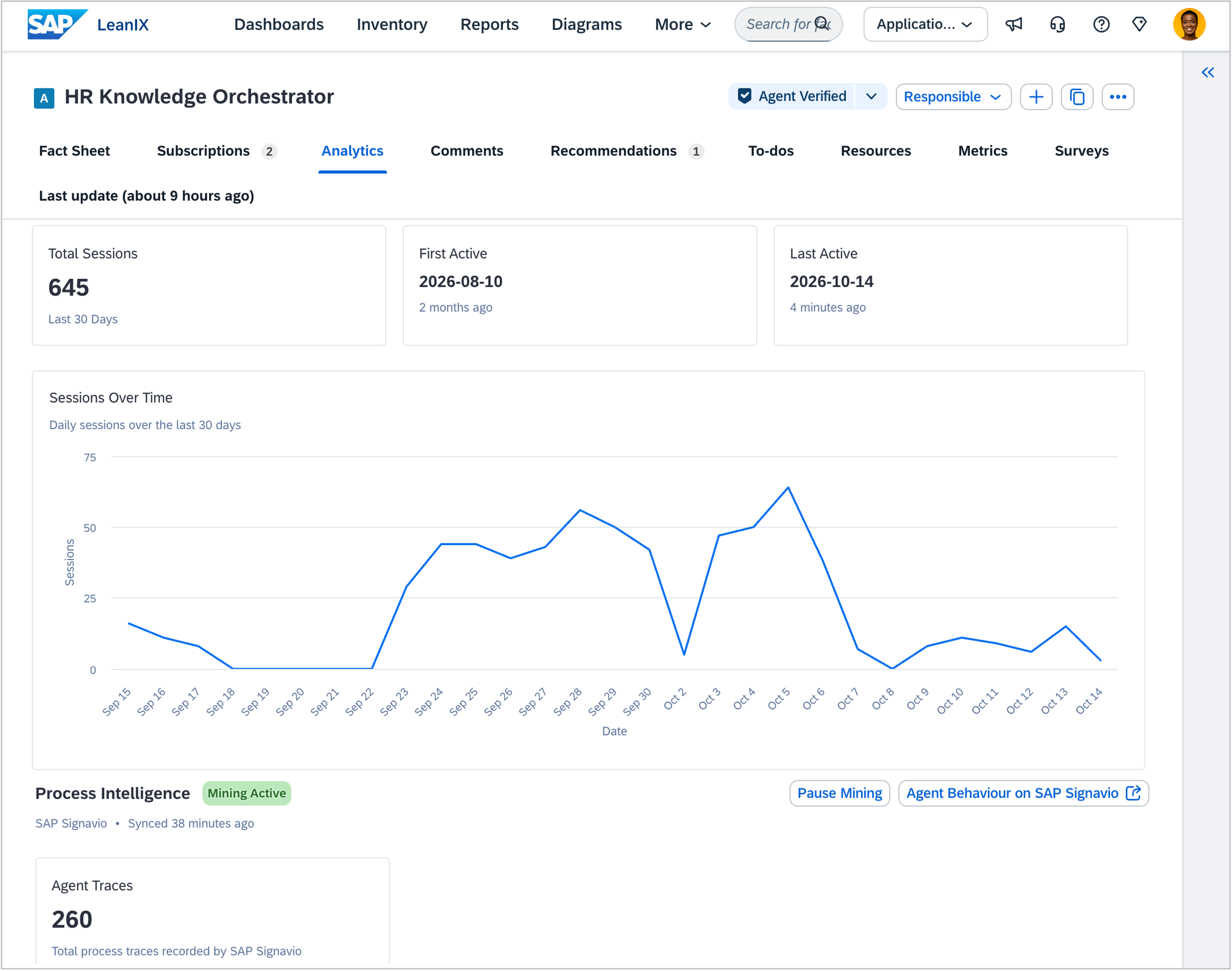
The new SAP AI agent discovery integration as part of the SAP AI Agent Hub provides this comprehensive view. In addition to rich metadata, such as ownership, version, environment, and lifecycle information, it connects each agent with capabilities across the SAP ecosystem:
Identity: Agent identities provided by SAP Identity Services
Monitoring and auditability: Operational insights from SAP Cloud ALM
Process insights: Agent mining insights from SAP Signavio
Together, these connections give you a unified view of your SAP agents from discovery and identity to operational behavior and business-process impact.
Govern agents as logical entities
An agent may run across multiple tenants or environments, but it remains a single logical entity that should be managed and governed consistently. Within your workspace, each agent is represented by a single logical fact sheet and lists its individual deployments in a dedicated Instances section.
Only the logical agent fact sheet counts towards your fact sheet quota, not each individual instance.
Turn verification into runtime enforcement
Agent verification can now directly impact runtime. You can define the tenants in which verification is required. If an agent operating in one of these tenants has not been verified, incoming calls to the agent will not be processed. Previously, verification status primarily documented an agent’s governance state. It can now serve as an operational control applied where needed, allowing you to govern an agent centrally while enforcing verification requirements for specific runtime environments.
In order to fully benefit from these enhanced capabilities, you need to be a customer of the SAP Business AI Platform.
Features in progress
Eliminate data inconsistencies across workspaces without custom development
Keep architecture data consistent across multiple workspaces without building a custom integration. Originally planned for September and now set for release in the first half of November, a new self-service integration replaces custom-built solutions with a governed sync mechanism you control. Whether you want to push lifecycle decisions and retirement guidance from a corporate workspace down to business units, or collect ownership and deployment details across peer workspaces, you define exactly what gets synced and how, with configurable filters, attribute and relation mapping, and conflict resolution options.


Plan IT components successors with the help of the EA Assistant
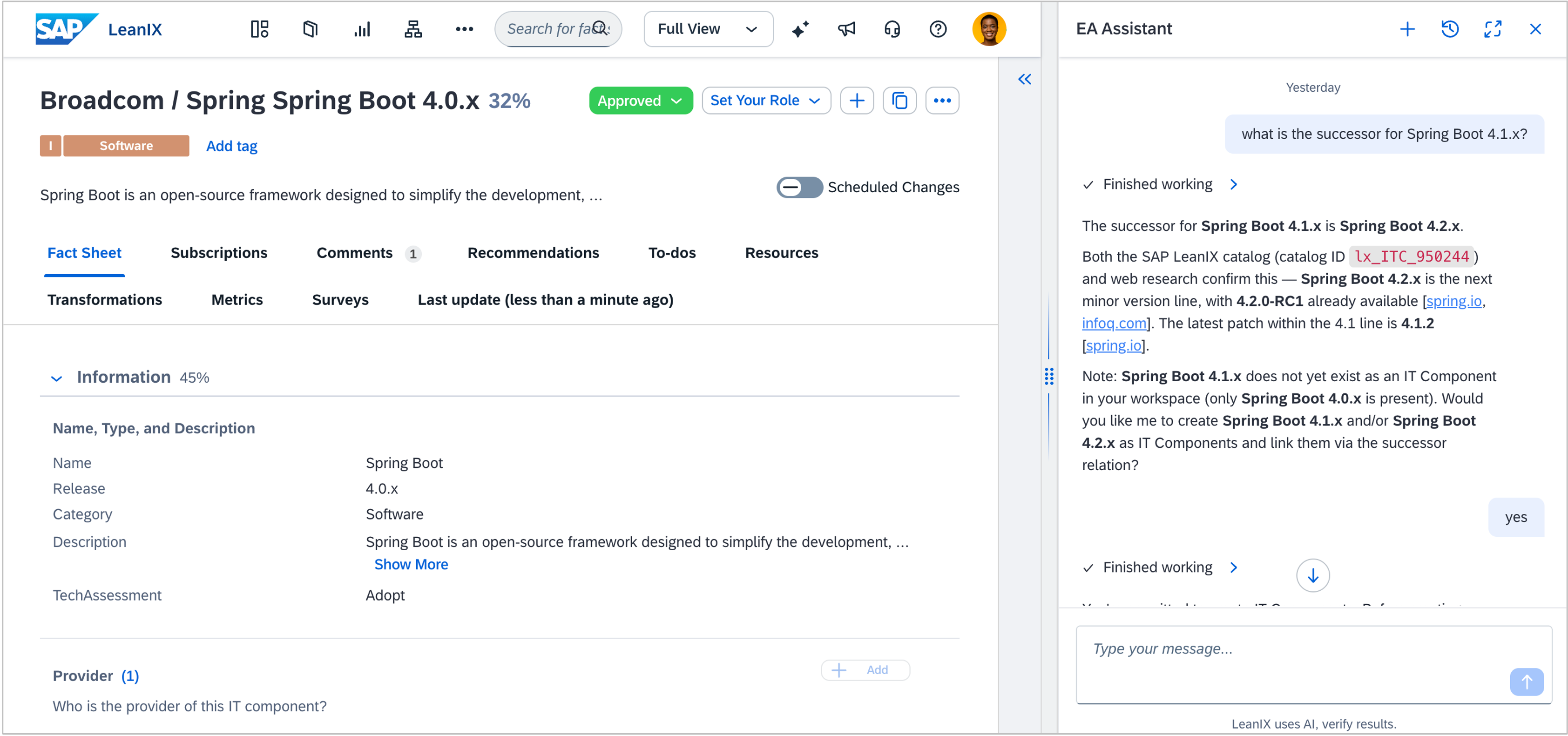
Managing version currency across your technology landscape is time-consuming and error-prone, especially when identifying newer versions, gauging how far behind you are, and manually creating the right successor fact sheet and wiring up the relationship. A new Enterprise Architecture Assistant skill to be released at the beginning of November will handle that work for you: triggered directly from a versioned IT component fact sheet, it searches the reference catalog and the web to surface available newer versions, shows you how far behind your current version is, and lets you choose a migration target that fits your organization's risk tolerance.
Once you've made your selection, the skill will automatically create the successor IT component fact sheet and establish the successor relationship, turning what used to be a multi-step research-and-data-entry task into a guided action in seconds. This gives technology managers, enterprise architects, and risk and compliance officers a structured, consistent way to act on version currency, whether the driver is vulnerability exposure, an internal upgrade policy, or the need to build a realistic successor roadmap.
This first iteration focuses on individual fact sheets and covers the two core actions: creating the successor fact sheet and linking it to the original. Portfolio-wide scanning and broader transformation planning are not in scope for this release.
Manage your optional and beta features via self-activation
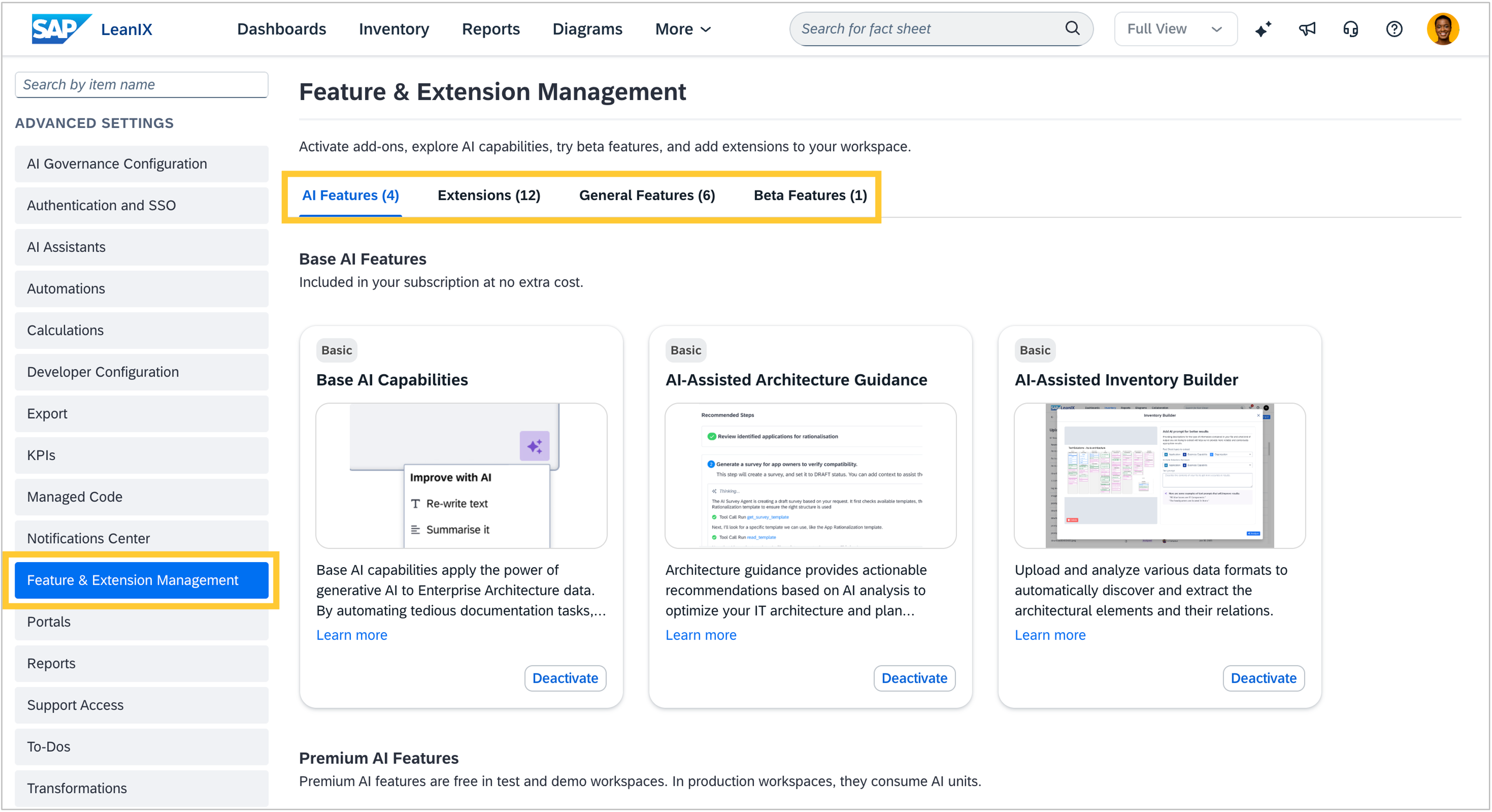
The admin page for managing optional features is being restructured on November 13 to make feature activation easier to navigate, and the cost model of AI features more transparent. You will see at a glance which AI capabilities are included in your subscription (Base AI) and which consume SAP AI Units (Premium AI), a distinction that was not obvious before.
The page will be renamed from "Optional Features and Early Access" to "Feature & Extension Management" and its single long-scroll layout will be replaced with four focused tabs: AI Features, Extensions, Beta Features, and General Features. A card-based design with clearer labels and descriptions will let you scan and activate the right capability faster.
Before the end of the year, a new Beta Features tab on the page will let admins of eligible workspaces try selected functionality before it's generally available, with each beta displaying its availability window. Betas will only be visible and activatable in a sandbox workspace, require a signed Test and Evaluation Agreement, and auto-expire after a defined timeframe, such as 90 days. The clearly labeled low-risk way lets you explore upcoming capabilities and share early feedback. Details about the process to sign the agreements to become eligible for betas will be shared with the release.
Events
Review our product roadmap webinar for Q4 2026
If you were unable to join the live SAP LeanIX product roadmap update for Q4 to obtain an overview of our strategic outlook and a comprehensive update on what's coming in the next few months, the recording is available through our public roadmap and directly via this link.

Thank you for reading our newsletter. Join the SAP LeanIX Community to ask questions, get expert answers, find solutions to common challenges, and collaborate with others using SAP LeanIX. Stay updated on newly released features and bug fixes by checking out and subscribing to SAP LeanIX Product Updates. If you are reading this newsletter as an email, you can visit updates.leanix.net to view any explanatory videos embedded in this newsletter.
Visit our roadmap to see what is on the horizon and to share your feature ideas and feedback. If you want to report a bug or request a configuration change, let us know at SAP for Me.
Best Regards, Your SAP LeanIX Team
SAP (Legal Disclosure | SAP) This e-mail may contain trade secrets or privileged, undisclosed, or otherwise confidential information. If you have received this e-mail in error, you are hereby notified that any review, copying, or distribution of it is strictly prohibited. Please inform us immediately and destroy the original transmittal. Thank you for your cooperation.
You are receiving this e-mail for one or more of the following reasons: you are an SAP customer, you were an SAP customer, SAP was asked to contact you by one of your colleagues, you expressed interest in one or more of our products or services, or you participated in or expressed interest in participating in a webinar, seminar, or event. SAP Privacy Statement
This e-mail was sent to you on behalf of the SAP Group with which you have a business relationship. If you would like to have more information about your Data Controller(s), please click here to contact webmaster@sap.com.
This e-mail was sent to you by SAP and provides information on SAP's products and services that may be of interest to you. If you received this e-mail in error, or if you no longer wish to receive communications from the SAP Group of companies, you can unsubscribe below.
To ensure you continue to receive SAP-related information properly, please add updates@leanix.net to your address book or safe senders list.