- DATE:
- AUTHOR:
- SAP LeanIX Product Team
Product update - March 2026
We updated the newsletter's announcement section to provide you with an overview of major change initiatives. This is designed to give you a central place to track initiatives that may require action on your end. The headlines either include a link to the respective announcement, or you can find the details in this newsletter. The most important call to action is to review your SSO setup by May 15 to ensure access to your workspace. Enjoy the detailed overview and near-term outlook.
Announcements
Upcoming major changes
April 30, 2026: View usage and adoption metrics within your workspace - Gainsight 360 goes end of life (see below under 'Recent feature releases')
NEW: June 30, 2026 / September 30, 2026: Keep visibility of past relations when running transformations (see below under 'Features in progress')
May 15, 2026: Action required: SSO migration deadline approaching (see below)
March 2027: Poll API deprecation: Transition to the new survey API
Action Required: SSO migration deadline approaching — May 15, 2026
As we have shared over the past months, organizations using Single Sign-On (SSO) to access SAP LeanIX must migrate to the new authentication service by May 15, 2026. With less than two months remaining, we encourage you to complete this step as soon as possible to ensure uninterrupted access to your workspace.
Who needs to act?
This applies to organizations that currently use SSO for login authentication and were onboarded before July 2025. Detailed configuration guides are available on the SAP Help Portal — the migration can be completed independently, without contacting support. If your workspace uses username/password authentication, if you have already completed the migration, or if it was set up after July 2025, no action is required.
Need guidance? Join our webinar on March 31.
We are hosting a live session on March 31, 2026, at 10:00 AM EDT / 4:00 PM CEST, where our product experts will walk through the full migration process, address common challenges, and answer your questions. Register here.
Recent feature releases
Let AI guide you to optimize your IT landscape
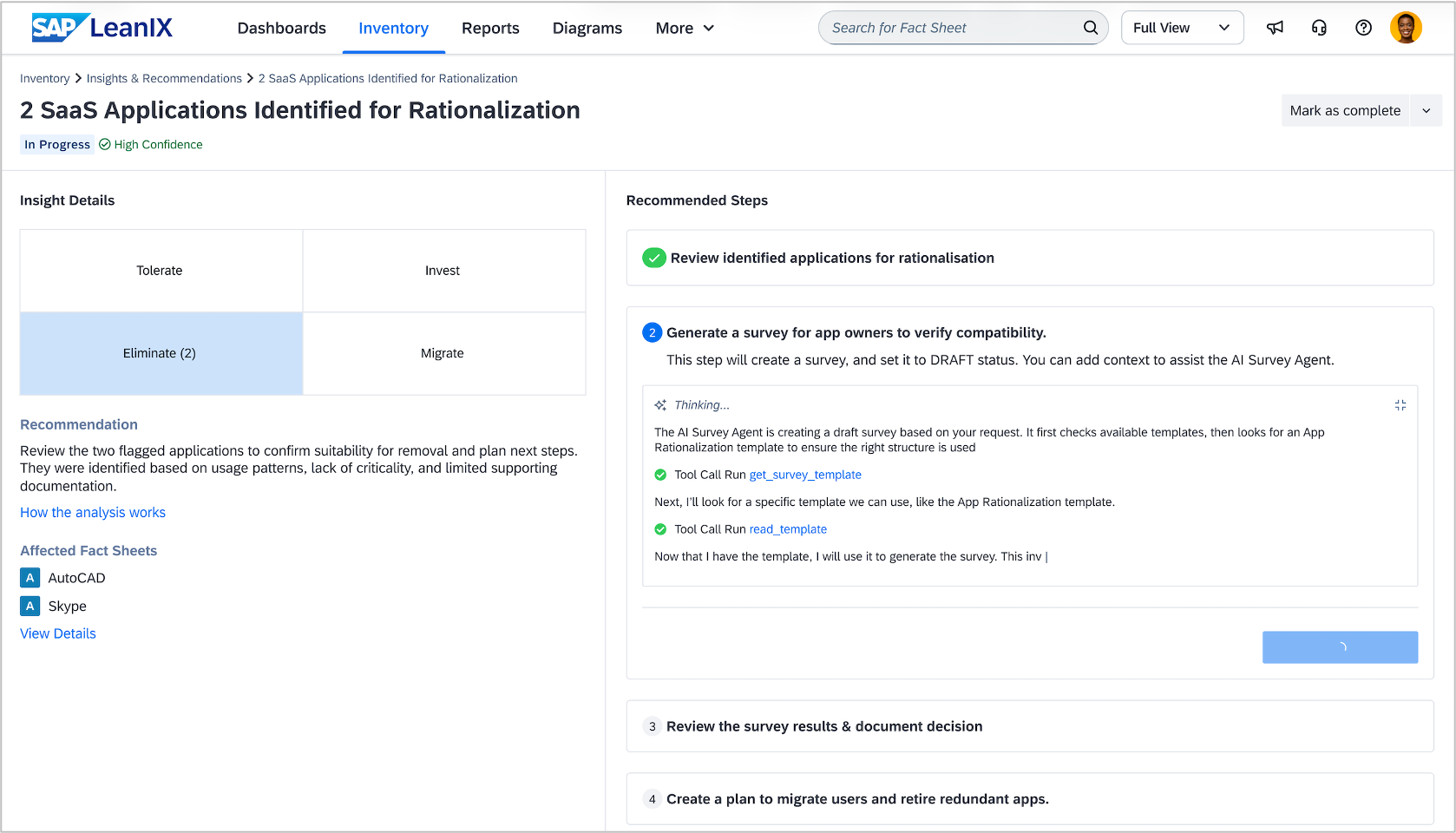
Analyzing your IT landscape for improvement opportunities is one of the most time-intensive tasks in enterprise architecture. With AI-assisted architecture guidance, we take a step toward doing this analysis for you — surfacing insights that highlight areas for improvement and guiding you through the steps to act on them. Architecture guidance analyzes your inventory and identifies concrete opportunities to optimize your IT landscape. It combines data from your workspace with anonymized benchmarks from organizations of similar industry and size, giving you insights that reflect both your specific context and industry best practices.
Two insights at launch
Architecture guidance launches with two insight types. TIME classification applies the Gartner TIME framework to your application portfolio, comparing technical and functional fit against industry benchmarks to surface rationalization candidates. Feature redundancy identifies applications with overlapping functionality, helping you consolidate and reduce complexity. Each insight comes with recommended steps that help you act — use AI to instantly create survey drafts, document architecture decisions, and plan transformations, all within your existing workflows. You stay in control, reviewing and confirming every AI-generated artifact before it is finalized.
How to get started
Architecture guidance is available to admin users in workspaces with SAP LeanIX Application Portfolio Management and is disabled by default. Activate it under Administration > Optional Features & Early Access. Once activated, it will appear under the "More" button in the main navigation bar. For detailed setup instructions and documentation, see the SAP Help Portal.
A first release — built to grow
This is the first release of AI-assisted architecture guidance. Because insights are derived from your specific workspace data, industry context, and organizational structure, they are inherently context-sensitive — meaning results will vary across workspaces in ways that other features typically don't. Over the coming months, we will closely monitor how insights perform across different environments to understand where guidance is already strong and where it needs to improve. Your feedback plays a key role in this process — use the thumbs-up or thumbs-down option on any insight to help us learn and refine the results.

Get more out of AI agents connected to your workspace via the MCP server
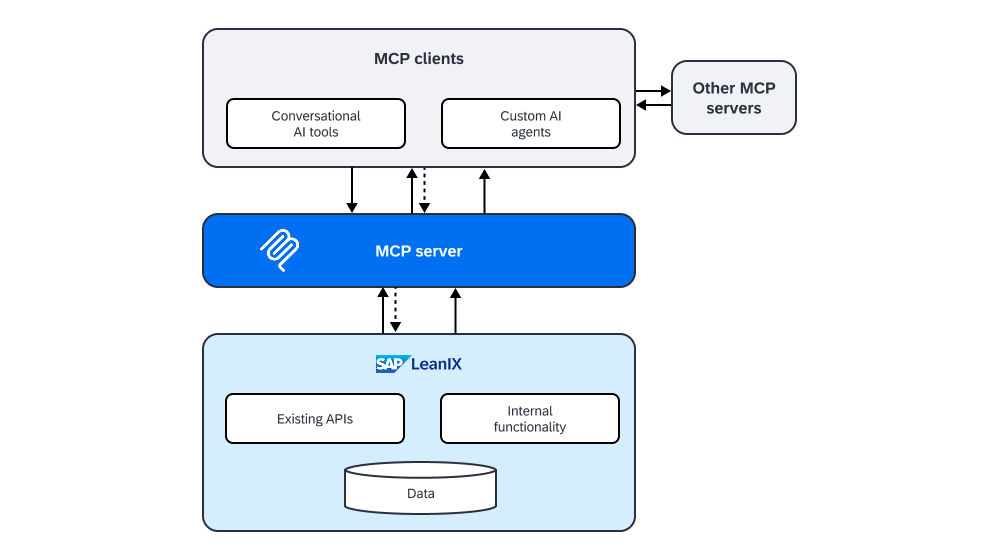
Since its release in November 2025, we have substantially updated our MCP server. AI agents and custom applications connected via the MCP server — whether through Claude, Microsoft Copilot Studio, Cursor, or other MCP-compatible clients — now have access to a richer and more reliable toolset.
New capabilities
Querying applications now better supports filtering by lifecycle phase and fact sheet subtype, making it straightforward to ask questions like: “Which active microservices are approaching end of life?” Additionally, all tools now return direct links, so agents can point users straight to the relevant item in a workspace.
Stability, security, and bug fixes
Core operations are now substantially more stable, errors are properly surfaced to agents, and we have refined tool descriptions for better compatibility with Microsoft Copilot Studio. We also increased rate limits to support agent workloads with high tool-call volumes. If you use technical users with access control entities within virtual workspaces, you can now connect to the MCP server without restrictions. Lastly, field-level visibility rules are now respected: hidden fields are fully omitted from responses rather than returned with empty values, preventing agents from inadvertently exposing restricted field names.
What’s next?
As announced in our product roadmap, we are working to open the MCP server to all users by enabling user-based access via OAuth. After that, we will allow agents to perform inventory data changes (create, update, and delete) via the MCP server.
Want to contribute?
With each update, we run proprietary automated evaluations (EVALs) to test the impact of changes on the accuracy and reliability of agent responses. If you have created skills, agents, or scripts running against our MCP server and want us to include respective EVALs in our pipeline, please reach out to us via the above roadmap item.
Automatically discover tech stack versions & lifecycle data
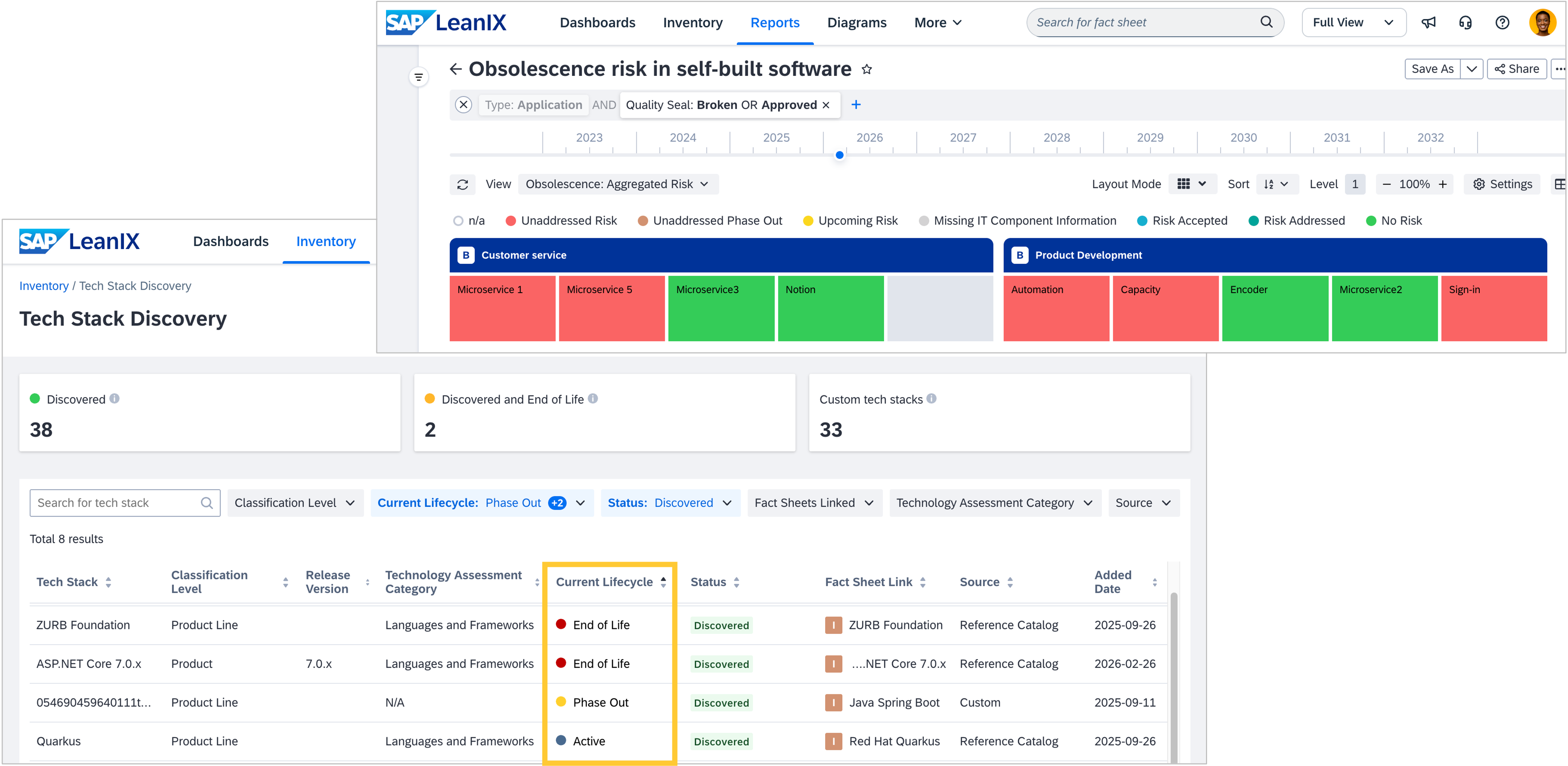
The IT stack of many companies is increasingly composed of large estates of self-built software. Based on customer feedback, we are extending the discovery of the technology stack for ingested SBMOs beyond microservices and tech stacks to include version-level details and end-of-support data.
For workspaces with SAP LeanIX Technology Risk and Compliance, when you discover tech stacks (languages and frameworks) from your SBOMs, we now automatically look for tech stack versions (e.g., "Spring Boot 3.5") and match them against the reference catalog to surface end-of-support dates. In case you use custom or proprietary frameworks within your organisation, you can now define your own tech stack versions, add lifecycle data, and specify purl matching rules for incoming purls, getting the same governance visibility as open-source frameworks. The result is an accurate, version-level tech debt discovery and obsolescence risk aggregation for self-built applications with zero manual work.
Key Benefits:
No more surveys to gather versions and lifecycles – Version data is automatically extracted and kept current as code evolves
Proactive obsolescence risk management – Discover end-of-support tech stacks before they become tech debt
Support for custom frameworks – Define your own proprietary tech stack versions and end-of-support dates
Accurate modernization planning – Know exactly which applications need to run on modern technologies and prioritize investments
Compliance and security – Catch security windows and compliance drift for unsupported versions automatically.
View adoption metrics within your workspace – Gainsight Shared 360 goes end of life
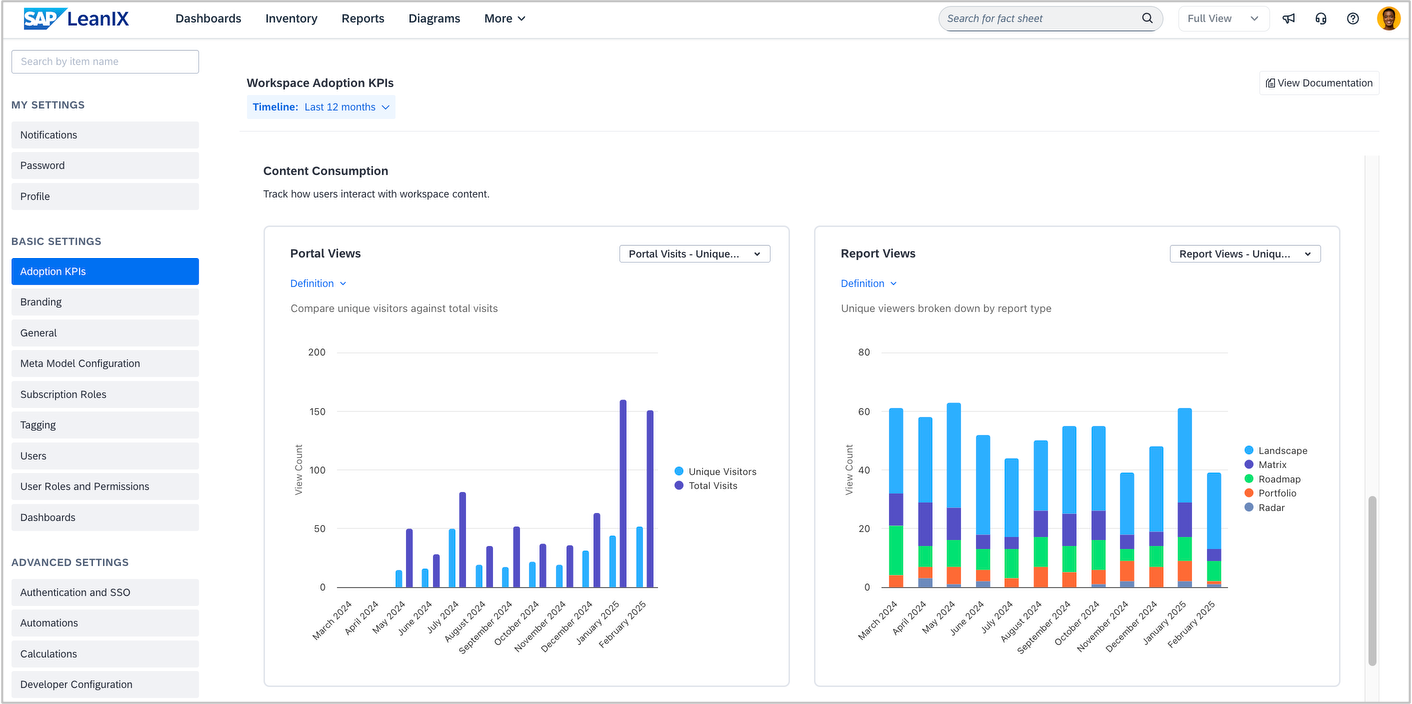
We are excited to share that the usage and adoption metrics (e.g., number of workspace log-ins, number of report views) previously available in Gainsight Shared 360 have been migrated to your SAP LeanIX workspace. Shared Gainsight 360 will be deprecated by the end of April (one month later than communicated before). This means admins can access adoption metrics directly from the workspace admin area without relying on an external dashboard with a separate login. As part of the change, we have streamlined and refined our metrics to provide deeper insights, for example, by including logins broken down by user attributes and consumption data for diagrams and dashboards.
In addition to the usage and adoption metrics, the Gainsight Shared 360 contained information on raised support tickets and product ideas. You can continue to access your support tickets via SAP for Me. As of now, the status of submitted product ideas will no longer be visible after April 30, 2026. We have already started to assess ways to reintroduce the previous functionality directly via our public roadmap. To share updates as they become available, we have created a portal card on our public roadmap where you can see the status incl. a first update. The overall feedback process for new ideas remains unchanged, so please continue submitting feedback and ideas. Your CSM can provide status updates on specific submissions upon request.
Continue your work while importing data
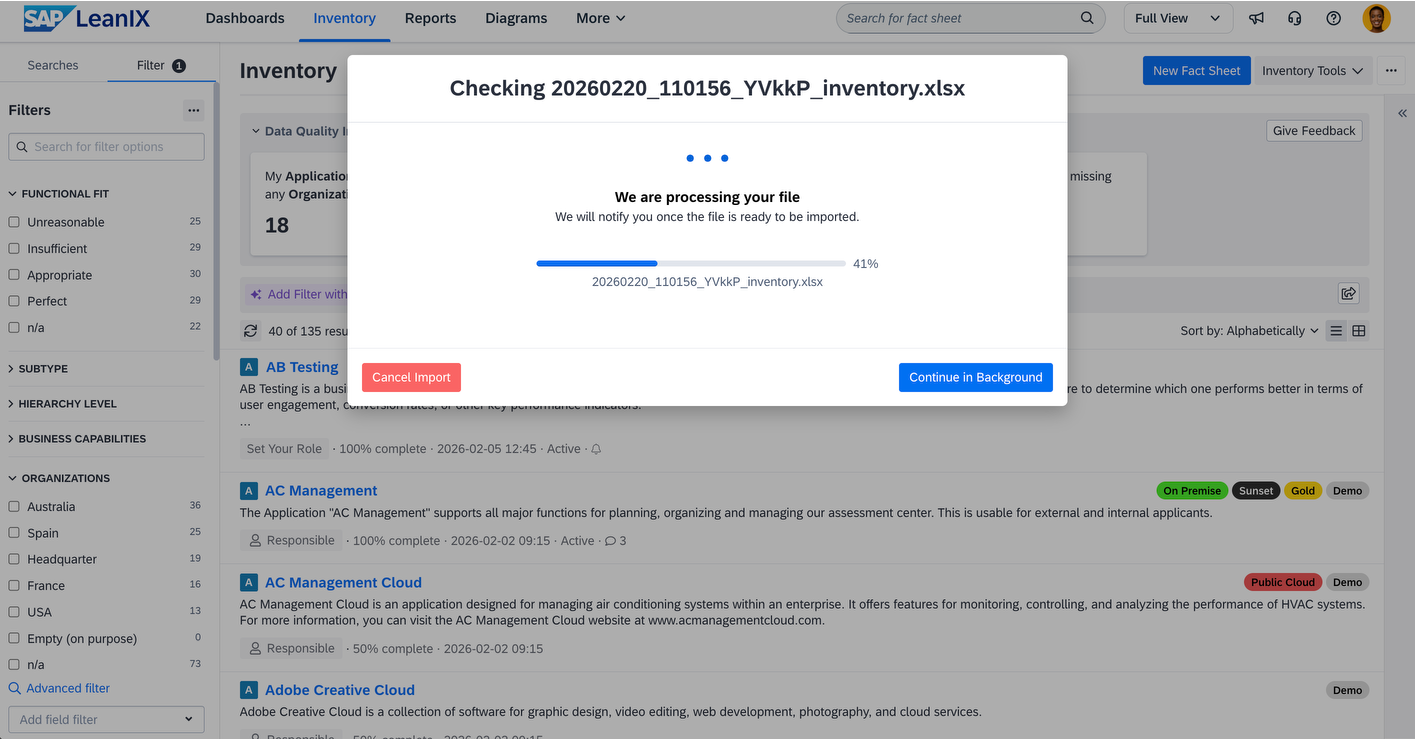
We introduced a significant upgrade to the Excel import experience designed to enhance resilience and greater scalability while preserving the familiar workflow you rely on for bulk importing data into your workspace. The new asynchronous import process runs entirely in the background, allowing you to continue your work in parallel. A real-time progress widget in the inventory side-panel keeps you informed of import status, and you are prompted to review and accept results upon completion.
This enhancement also improves error resilience through a single-line processing architecture, which better handles cross-referenced data within import files, addressing dependency scenarios that previously required careful manual management. For very large imports, the import runtime may vary with the new architecture. However, import performance for more than 95% should not change. We are actively optimizing performance to ensure processing times remain comparable to those of the previous import experience.
This upgrade represents our commitment to providing robust, scalable tools that support your enterprise architecture objectives while maintaining workflow continuity. A temporary issue after the release that caused large imports to get stuck at 0% progress has been fixed.
Features in progress
Close the gap between architectural design and transformation execution
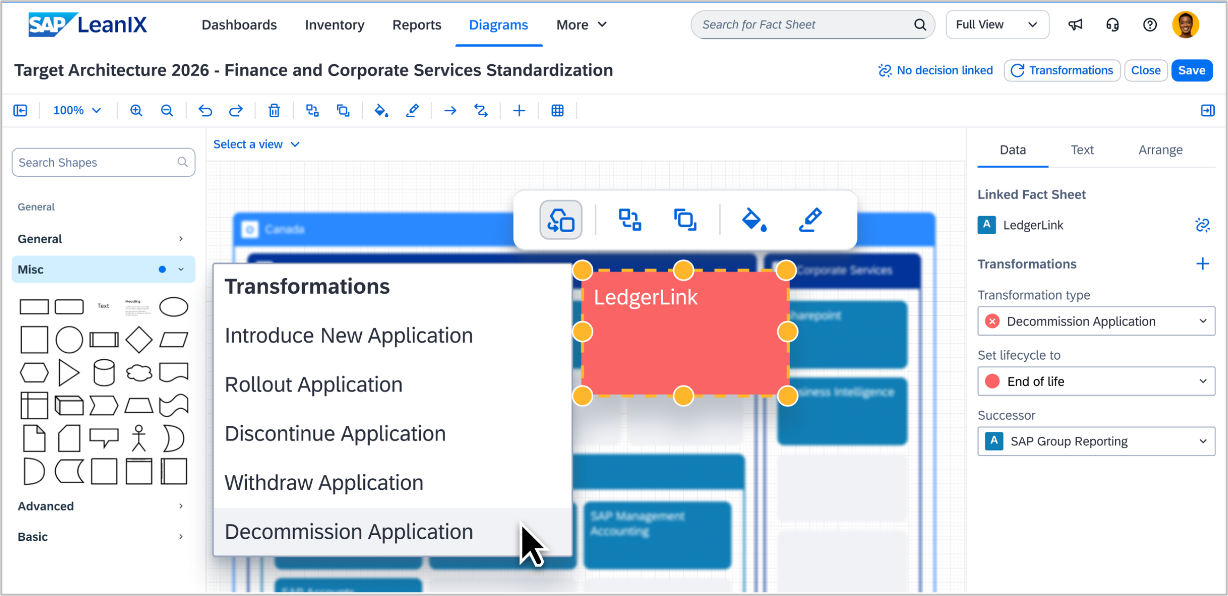
We are evolving our target architecture planning capabilities with new features launching by mid-May, giving you a connected, end-to-end way to design, decide, plan, and govern your target architecture without losing context as you move from one phase to the next.
You will be able to use diagrams to design your target architecture based on your as-is inventory and existing diagrams, and create and manage transformations directly within them through a guided experience. Diagrams and architecture decisions will be bidirectionally linked, making your design intent traceable from execution back to intent. Architecture decisions can also be created using AI, making it easier to capture and document your design rationale.
Transformations created in your diagrams automatically flow into the transformation explorer, where you can manage all planned changes across initiatives, move transformations between initiatives, set milestones, and navigate directly to roadmap views. The roadmap report gains visual milestone editing, so you can adjust your transformation milestones without leaving the report.
Target architecture planning will continue to evolve throughout 2026 with further iterations after the initial launch.

Keep visibility of past relations when running transformations
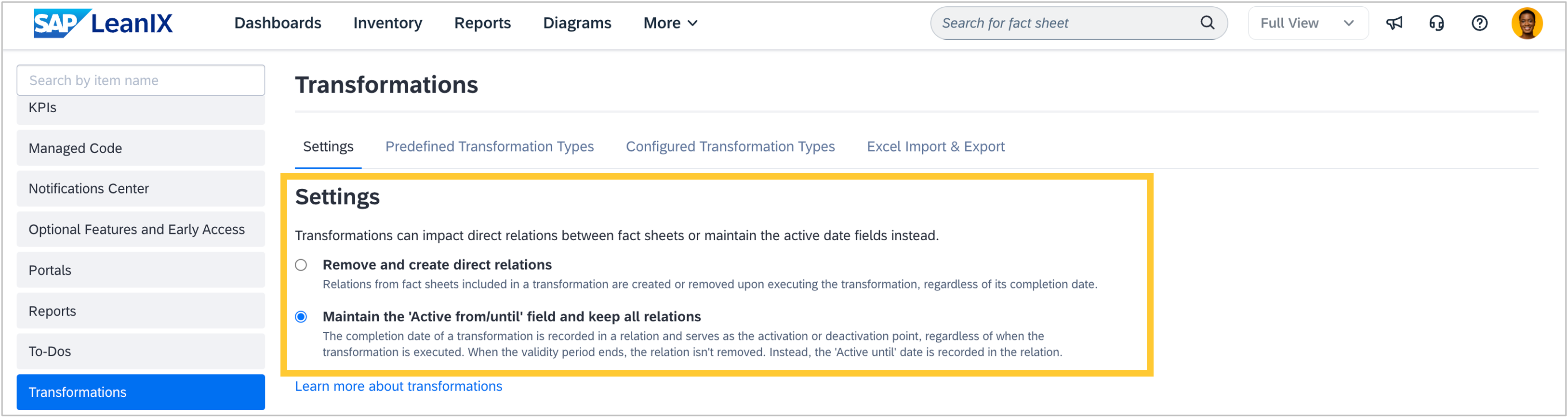
Understanding how your IT landscape has evolved — and where it is headed — requires data that reflects both past and future states. As a step towards that, we are giving you access to past relation data by streamlining the approach how relations are updated during transformations: In workspaces with SAP LeanIX Architecture and Road Map Planning, every relation within a transformation will carry a validity period instead of being silently removed when a transformation runs, preserving past, present, and future states across inventory, reports, and APIs. This update covers relations only. In the future, certain field types will also become time-aware — we will keep you informed when that time comes.
What does that mean for you?
If you have no existing transformations yet, the change will be applied automatically on June 30, 2026, with no action required.
If you have existing transformations, we will apply the change on September 30, 2026. Once applied, past relations will become visible in your workspace.
We will reach out to the main workspace contacts via email for both scenarios, with more details, ahead of the date we apply the change.
Bring contract data to your EA practice
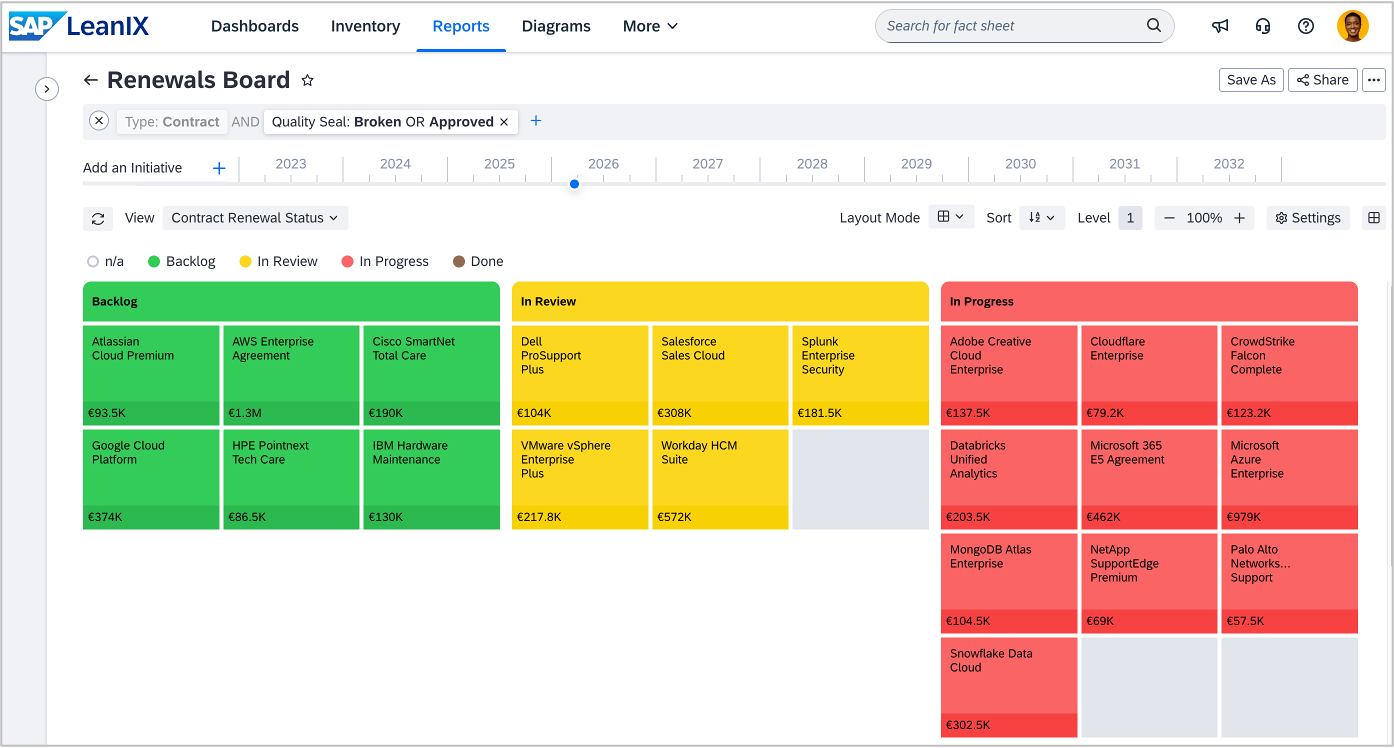
Contracts are the connective tissue of your IT landscape, linking applications and providers to the financial commitments and renewal timelines that govern them. By mid-May, we will introduce an optional contract fact sheet type as an extension to the meta model. With dedicated fields and relations, you can surface all relevant connections to your IT inventory in your workspace, making upcoming expirations, overdue renewal decisions, and unlinked contracts visible before they become problems. Use renewal notifications and dashboards to build contract governance into your existing EA workflows. If you already track contracts for DORA compliance or work on application total cost of ownership (TCO), we will guide you on how to best represent the use cases.
The Store becomes the Extension Hub
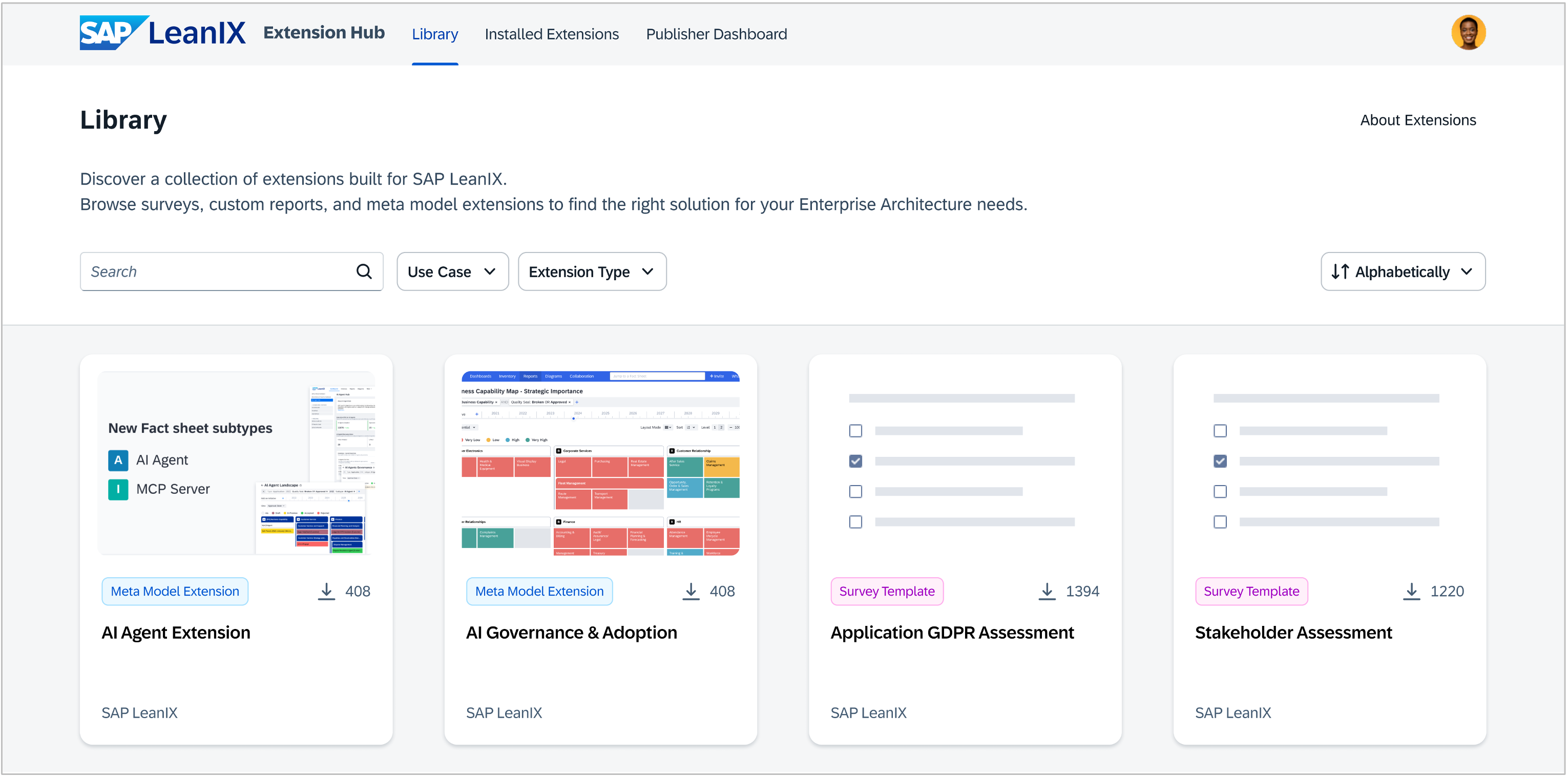
In April, the SAP LeanIX Store is relaunching as the SAP LeanIX Extension hub — the first step in transforming how you can discover, implement, and share productized best practices and extensions. The vision is a unified, scalable hub that serves as the central repository for reusable configurations and customizations, empowering you to easily adopt and contribute extensions that enhance your SAP LeanIX experience.
The relaunch brings a new UI and expands the hub's content. Custom reports and survey templates remain available, and the extension hub will introduce its first new extension type: Meta model extensions. Previously accessible through the workspace admin area, they will move to the extension hub, where you can browse and discover what is available, with a streamlined installation experience.
This initial release focuses on SAP LeanIX-sourced content, with the foundation in place to support more extension types and broader contributions in the future.
Events
Learn about our product roadmap for Q2 2026
It is time to register for the SAP LeanIX product roadmap update Q2/2026 on April 16, 2026, at 5:00 pm CET / 11:00 am EDT.
Join our host and speakers from the SAP LeanIX product team for a deep dive into our product strategy 2026 to discover our latest features and work in progress on the Q2 2026 roadmap. We will share a registration page with you in the next month.

Thank you for reading our newsletter. Join the SAP LeanIX Community to ask questions, get expert answers, find solutions to common challenges, and collaborate with others using SAP LeanIX. Stay updated on newly released features and bug fixes by checking out and subscribing to SAP LeanIX Product Updates. If you are reading this newsletter as an email, you can visit updates.leanix.net to view any explanatory videos embedded in this newsletter.
Visit our roadmap to see what's on the horizon and to share your feature ideas and feedback. If you want to report a bug or request a configuration change, let us know at SAP for Me.
Best Regards,
Your SAP LeanIX Team
SAP (Legal Disclosure | SAP)
This e-mail may contain trade secrets or privileged, undisclosed, or otherwise confidential information. If you have received this e-mail in error, you are hereby notified that any review, copying, or distribution of it is strictly prohibited. Please inform us immediately and destroy the original transmittal. Thank you for your cooperation.
You are receiving this e-mail for one or more of the following reasons: you are an SAP customer, you were an SAP customer, SAP was asked to contact you by one of your colleagues, you expressed interest in one or more of our products or services, or you participated in or expressed interest to participate in a webinar, seminar, or event. SAP Privacy Statement
This e-mail was sent to you on behalf of the SAP Group with which you have a business relationship. If you would like to have more information about your Data Controller(s), please click here to contact webmaster@sap.com.
This e-mail was sent to you by SAP and provides information on SAP’s products and services that may be of interest to you. If you received this e-mail in error, or if you no longer wish to receive communications from the SAP Group of companies, you can unsubscribe below.
To ensure you continue to receive SAP related information properly, please add updates@leanix.net to your address book or safe senders list.